Military program working to identify two Brandon soldiers killed in 1917
-
Share on Facebook
-
Share on Bluesky
-
Share on X
- Copy Link
It’s been decades since Canadians fought in various wars, but thousands of soldiers remain missing.
The Canadian Armed Forces is working to identify newly discovered remains and unmarked graves through its Casualty Identification Program.
“The modern program focuses on two different sorts of identification cases. Remains cases investigate modern discoveries of human remains, while graves cases investigate individuals who have already been buried as unknown soldiers in Commonwealth War Graves Commission cemeteries,” said historian Alexandra McKinnon.
Human remains are increasingly being uncovered in areas undergoing new development, prompting the Canadian Armed Forces to use historical research and forensic tools to identify the soldiers.
“We’re using historical research; we’re looking at what units are moving through an area, who’s missing from an action, what we know about the circumstances of somebody’s death. We’re using forensic anthropology, so what the human remains themselves can tell us: how old somebody might have been, how tall they might have been.”
Among those the armed forces are trying to identify are Privates Harold Arthur Lindsay and Robert Nichol Grant, both of whom were from Brandon.
“They were both born in 1896. Private Lindsay was 20 years old at the time of his death. Private Grant had just turned 21. Both of them were born and raised in Brandon. Both of them volunteered to serve with the Canadian Expeditionary Force.”
Grant and Lindsay were deployed to France for the Battle of Hill 70 in 1917, where they were among more than 1,300 Canadian soldiers who lost their lives.
McKinnon says family members could help investigators identify some of the missing soldiers by coming forward with information.
“We would be thrilled to hear from anyone who may have information. However, there is no guarantee the men will be identified. Both are among the more than 1,300 Canadians still missing from this battle, and they remain on lengthy lists of potential candidates in these cases.”
While identification is not guaranteed, the program recently identified another Brandon soldier whose grave had been unmarked for more than a century.
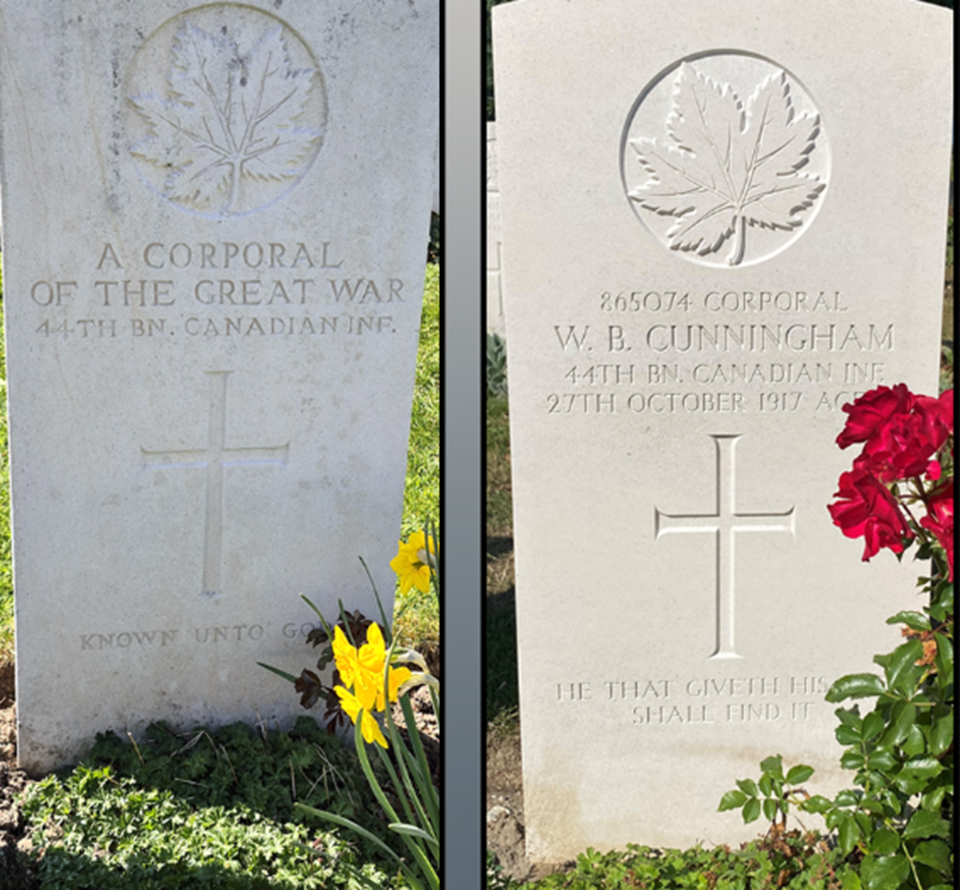
“Corporal William Benjamin Cunningham was what we call a graves case, meaning he was buried as an unknown soldier. Cunningham, a clerk from Brandon who was born in Hayfield, Manitoba, was buried as an unknown corporal of the 44th Battalion for more than a century. Historical research eventually confirmed that he was the only soldier who could have been buried in that grave,” said McKinnon.
Anyone who believes an undiscovered family member may have served in the war can contact the Canadian Armed Forces through its Casualty Identification Program.